
Do state-owned energy companies meet the Minister of Finance's fundamental values?
On July 22, the Ministry of Finance published the “Annual Report of State-Owned Companies 2025.” In the Minister's foreword to the report, he states:
It is “natural and self-evident that the State make a reasonable demand for return on investment”.
“State companies must demonstrate that they create real value for society” and “that they fill a gap that other companies in the market cannot meet”.
“By their very nature, state companies hold a strong position and thus significant power, which must be handled with care.”
State companies must take care “not to extend their operations further than necessary and not to disrupt the competitive market with which they interface”.
“The freedom to operate and compete in a free market is a fundamental value, and state companies must not hinder or distort that competition through improper conduct.”
The operation of state owned companies “must meet the strictest requirements for transparency, accountability, and performance.”
We at Straumlind wholeheartedly agree with the Minister's words and believe they reflect the environment that Icelandic law requires for Icelandic companies operating in competitive markets.
The state of the energy market
A great deal has changed in the energy market since 2006, when electricity generation and retail sale became competitive markets: New electricity retailers have entered the market, trading platforms (ELMA and Vonarskarð) have begun operating, along with the rollout of smart meters, electric vehicles, charging infrastructure, and so on.
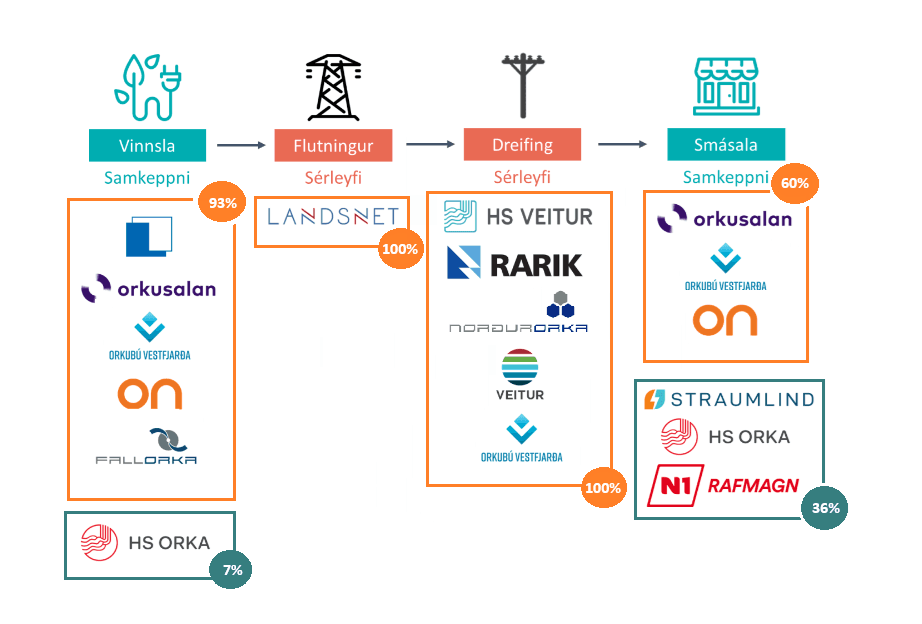
The State and municipalities are all-encompassing in the energy market. Public entities generate 93% of all electricity, transmit and distribute 100% of all electricity under exclusive concessions, and the market share of publicly owned electricity retailers is about 60%. Of the five publicly owned generators, three sell their production directly to their own retail division through internal sales, and one sells all of its production to a state-owned electricity retailer under a bilateral long-term agreement.
Under the current structure, most public entities in the energy market, owing to ownership and management ties, occupy some kind of hybrid role, both a public service provider expected to observe equal treatment, and a competitor in generation and retail expected to compete with others.
In Straumlind's view, these hybrid roles are a major reason why “the objective of Electricity Act No. 65/2003 concerning increased competition and consumer protection has not been achieved as it should have been over the almost twenty years the law has been in force,” as the Icelandic Competition Authority so aptly put it (see below). More specifically, the reasons are principally as follows:
1. Lack of separation of distribution utilities and affiliated electricity retailers causes persistent and insurmountable conflicts of interest.
Orkubú Vestfjarða
Producer, distributor and electricity retailer combined in a single company, which is only possible because of an exemption from the separation requirement in the Electricity Act. An anachronism that needs to change.
Rarik and Orkusalan
In Straumlind's view, there is no hope that the goal of strengthening competition in the energy market can be realized as long as Rarik and Orkusalan remain vertically integrated. The Electricity Act's provision on accounting separation of distribution and electricity retail, without any managerial separation between these entities, is wholly inadequate in the current market environment.
Rarik's CEO serves as chairman of the board of Orkusalan.
Orkusalan's dividend payments indicate a lack of independence from Rarik. Orkusalan pays a fixed annual dividend of ISK 250 million to Rarik regardless of operating results, as per information from its annual accounts.
Year | OS Profit (ISK m) | Dividend to Rarik (ISK m) | Dividend as % of OS profit |
2019 | 640 | 250 | 39% |
2020 | 849 | 250 | 29% |
2021 | 466 | 250 | 54% |
2022 | 85 | 250 | 294% |
2023 | 39 | 250 | 641% |
2024 | 365 | 250 | 68% |
2. Lack of equal opportunity among electricity retailers in purchasing power generated by the State.
Both Orkubú Vestfjarða and Orkusalan sell production from their own power plants almost entirely to their own sales divisions, and almost none of it on an equal-treatment basis on the open wholesale market.
Internal sales pose various risks regarding the conduct of a state-owned company in a competitive market, such as:
Cross-subsidization between the generation and sales divisions becomes possible.
Undercutting resulting from cross-subsidization becomes possible.
Internal sales by publicly owned companies should take place on market terms (in order to respect the arm's-length principle), and it is therefore necessary to supervise internal sales. Internal sales reduce the supply available on the wholesale market, which weakens price formation and competition in that market.
Many examples of improper conduct
In recent years, regulators have issued rulings in various cases confirming improper conduct by state- or publicly owned energy companies. In addition, there is a number of cases/complaints submitted to the Icelandic Competition Authority, the Electricity Regulatory Authority, and the Consumer Agency concerning the conduct of state- or publicly owned energy companies, which are still being processed. In Straumlind's view, these cases shed light on the weaknesses in the current structure of the energy market.
Warning from the Icelandic Competition Authority
In its comments on the draft amendment to Regulation No. 1150/2019 on electricity trading and metering, dated June 2, 2023, the Icelandic Competition Authority stated, among other things:
“The Icelandic Competition Authority has long pointed out that the objective of Electricity Act No. 65/2003 concerning increased competition and consumer protection has not been achieved as it should have been over the almost twenty years the law has been in force.”
The Competition Authority has also pointed to features of tacit coordination in the electricity market, i.e., coordinated responses among vertically integrated energy companies that limit competition.
Finally, the Competition Authority has pointed out that large and powerful public companies enjoy a significant competitive advantage over smaller, independent retail companies.
Problems in the energy market have worsened with increased competition
In Straumlind's view, problems in the energy market have worsened with increased competition in the market. Likewise, the harm caused by the lack of a healthy market is growing as more parties attempt to enter the market and as the former monopoly state enterprises increasingly need to defend their own market share. This must be addressed.
On April 10, 2026, Straumlind sent a letter to the Minister of Finance addressing, among other things, these matters. The letter states:
“Straumlind calls on the Minister of Finance to heed the company's information and warnings regarding the state of the electricity market and to work, by virtue of her position as the representative of the Icelandic State's shareholding, toward bringing about genuine improvements.
Straumlind further calls on the Minister of Finance to obtain information from Rarik's board on how it intends to respond to the information Straumlind has presented in this letter.
Straumlind is ready to meet with the Minister and to answer any questions the Minister may have.
Straumlind would like to mention two changes that the Minister of Finance could champion, which would improve the ability of all electricity retailers to operate on the basis of healthy competition:
Total separation of distribution companies and electricity companies.
That power generated by state-owned power plants be sold on trading platforms (ELMA and Vonarskarð) instead of through internal sales.”
The Article was first published on 24 July 2026 on Vísir.is as an Opinion